Small Kitchen Storage Ideas That Actually Work in Tiny Spaces
Rental-friendly small kitchen storage ideas tested in genuinely tiny kitchens: slim rolling carts, door-mounted racks, shelf risers, wall rails and the mistakes to avoid.
My first flat had a kitchen so small that opening the oven door blocked the only walkway. Two people could not cook in it. One person could barely turn around in it. It was also, eventually, the best-organized kitchen I have ever had — because it forced me to earn every centimetre.
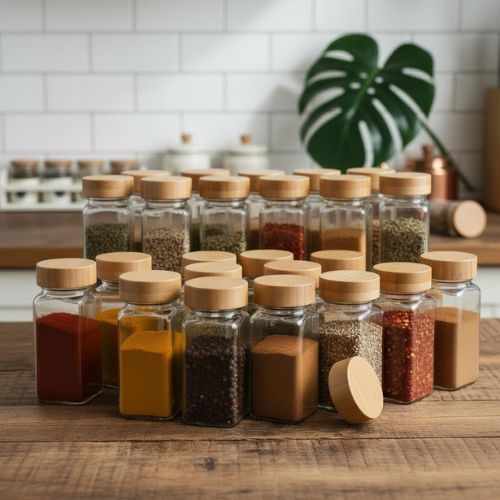
These are the storage ideas that survived that kitchen and the small kitchens I have helped organize since. No renovations, and almost everything here works in a rental.
Think in centimetres, not cabinets
Small-kitchen storage is a game of margins. A few centimetres above the door, behind a cabinet door, between the fridge and the wall — individually they seem like nothing. Together they can hold a surprising share of your kitchen.
The gap beside the fridge
If you have 12 centimetres or more between the fridge and the wall, a slim rolling cart fits there and holds tins, jars, oils and bottles two rows deep. Pull it out when cooking, push it back after. In my old flat this single cart replaced an entire missing pantry.
Inside cabinet doors
Adhesive hooks on the inside of a door hold measuring spoons and cups in order of size. A slim wire rack on the door under the sink keeps sponges and brushes off the sink edge. Door-mounted lid racks end the pot-lid avalanche without costing a single shelf.
The dead zone above the cabinets
If your cabinets stop short of the ceiling, that strip is long-term storage: the stockpot, the picnic set, the giant platter that appears twice a year. Matching baskets keep it from reading as clutter.
Make walls do the work of drawers
Counters are for prep; walls are for storage. A single rail with S-hooks along the backsplash holds your most-used utensils. A magnetic knife strip frees the knife block’s counter footprint. A narrow wall-mounted shelf turns an empty stretch of paint above the kettle into a home for mugs and coffee gear.
Double every shelf
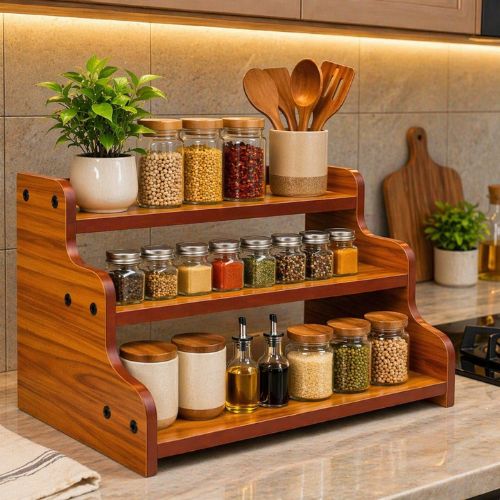
Most cabinet shelves waste half their height. Shelf risers create a second level for plates and bowls. Under-shelf hanging baskets catch napkins and small boards. Stackable can risers step tins upward so nothing hides at the back. None of these cost much, and together they roughly double a cabinet.
Choose tools that collapse, nest or stack
In a small kitchen, every purchase is a spatial decision. Nesting bowls that store as one, collapsible silicone colanders that flatten to two centimetres, stackable containers with one shared lid size. When a tool cannot earn its footprint, it does not come home.
Use the oven-adjacent drawer for what it is good at
That shallow drawer under the oven runs warm and awkward. It is a poor home for plastics and a great home for baking sheets, roasting tins and the flat things that fit nowhere else.
What not to do in a small kitchen
- Do not add a bulky freestanding unit before exhausting doors, walls and risers — furniture is the most expensive centimetre in the room
- Do not store anything you use daily above shoulder height; convenience beats appearance every time in a tight space
- Do not keep single-task gadgets that a knife or a pan already handles — the avocado slicer does not get a shelf of its own
- Do not block the work triangle with a cart or bin, no matter how clever it looks on Pinterest
The small-kitchen toolkit: what I actually reuse, kitchen after kitchen
Across every tiny kitchen I have organized — mine and other people’s — the same short list of gear keeps earning its place. None of it is exotic and none of it needs a drill:
- A slim rolling cart, 12–15cm wide, for the fridge gap. The single biggest storage gain per pound spent in a small kitchen
- Two sets of shelf risers for the cabinets with the most wasted vertical air — usually the plate and mug cabinets
- A tension rod under the sink to hang spray bottles by their triggers, freeing the floor of the cabinet for a bin or bucket
- Adhesive hooks in threes — door backs, side panels, the end of a cabinet run. Measuring spoons, oven mitts, the colander
- One magnetic knife strip, which returns a corner of counter that a knife block was squatting on
- Stackable clear containers with one lid size — clear so you see contents, one lid size so the lid drawer stops being a puzzle
Notice what is not on the list: anything decorative, anything single-purpose, anything that needs its own storage when not in use. In a small kitchen every object must pay rent.
The mindset shift: stop storing for a bigger kitchen
The deepest small-kitchen mistake is keeping an inventory sized for the kitchen you wish you had. Twelve dinner plates in a two-person flat. A stockpot for the annual batch of soup. Serving dishes for the dinner party the flat physically cannot host. I kept all of these through two small kitchens before admitting the obvious: the kitchen was not too small, the inventory was too big.
The honest sizing test: count the people you actually cook for in a normal month, add two for margin, and size your plates, glasses and cutlery to that number. Store true occasional pieces somewhere that is not the kitchen — the top of a wardrobe, under the bed, a labeled box in the hall cupboard. The kitchen keeps what the kitchen uses.
A realistic weekend plan
Small kitchens reorganize fast because there is less of everything. A workable schedule: Saturday morning, empty and purge zone by zone using the twelve-month rule. Saturday afternoon, put back only what earned its place, grouping by task. Sunday, live with it — cook two meals, notice the friction. Sunday evening, order only the gear the friction revealed: the riser for the cabinet that is still stacked double, the cart if the pantry overflow is real. The gear arrives midweek and slots into a system that already works.
Frequently asked questions
What is the best first purchase for a small kitchen?
If your fridge has a usable gap beside it: the slim rolling cart, no contest. If it does not, shelf risers for your most crowded cabinet. Both cost little, need no installation, and give back more space than anything else at their price.
How do I store small appliances in a tiny kitchen?
Vertically and honestly. The two or three appliances you use weekly deserve counter or front-of-cabinet space. Everything else lives high — above the cabinets, top of a shelf unit — and has to justify the climb each time. If an appliance has not made the climb worthwhile in a year, it is a donation, not a possession.
Are floating shelves worth it in a rental?
If you cannot drill, a freestanding ladder shelf against a spare wall gives most of the benefit without a single hole. If you can drill and the landlord allows it, two floating shelves above the kettle corner are the best-looking storage a small kitchen can add — just load them with daily-use items, not display pieces, or they become dusting duty.
Start with a purge, not a purchase
Every idea above works twice as well in a kitchen that has already been decluttered. If your cabinets are still full of duplicates and someday-tools, start with my guide to decluttering your kitchen, then come back. The full organizing system lives in how to organize your kitchen in 7 steps, and the rest of our kitchen coverage is on the kitchen guides page.
One last thought on small kitchens: they are not a punishment, and cooking in one is not a lesser version of cooking. Some of the best meals I have ever made came out of that galley kitchen where the oven door blocked the corridor. A small kitchen forces decisions a big one lets you avoid — what earns space, what earns counter, what earns your reach. Get those decisions right and a tiny kitchen runs smoother than most large ones, because everything in it is there on purpose. That is the whole game: not more room, better choices.
Sources & further reading
For readers who want to go deeper, these are the sources worth trusting: