
Best Home Workout Equipment for Small Spaces in 2026
Best Home Workout Equipment for Small Spaces in 2026 Building a home gym no longer requires a spare…
Best Home Workout Equipment for Small Spaces in 2026
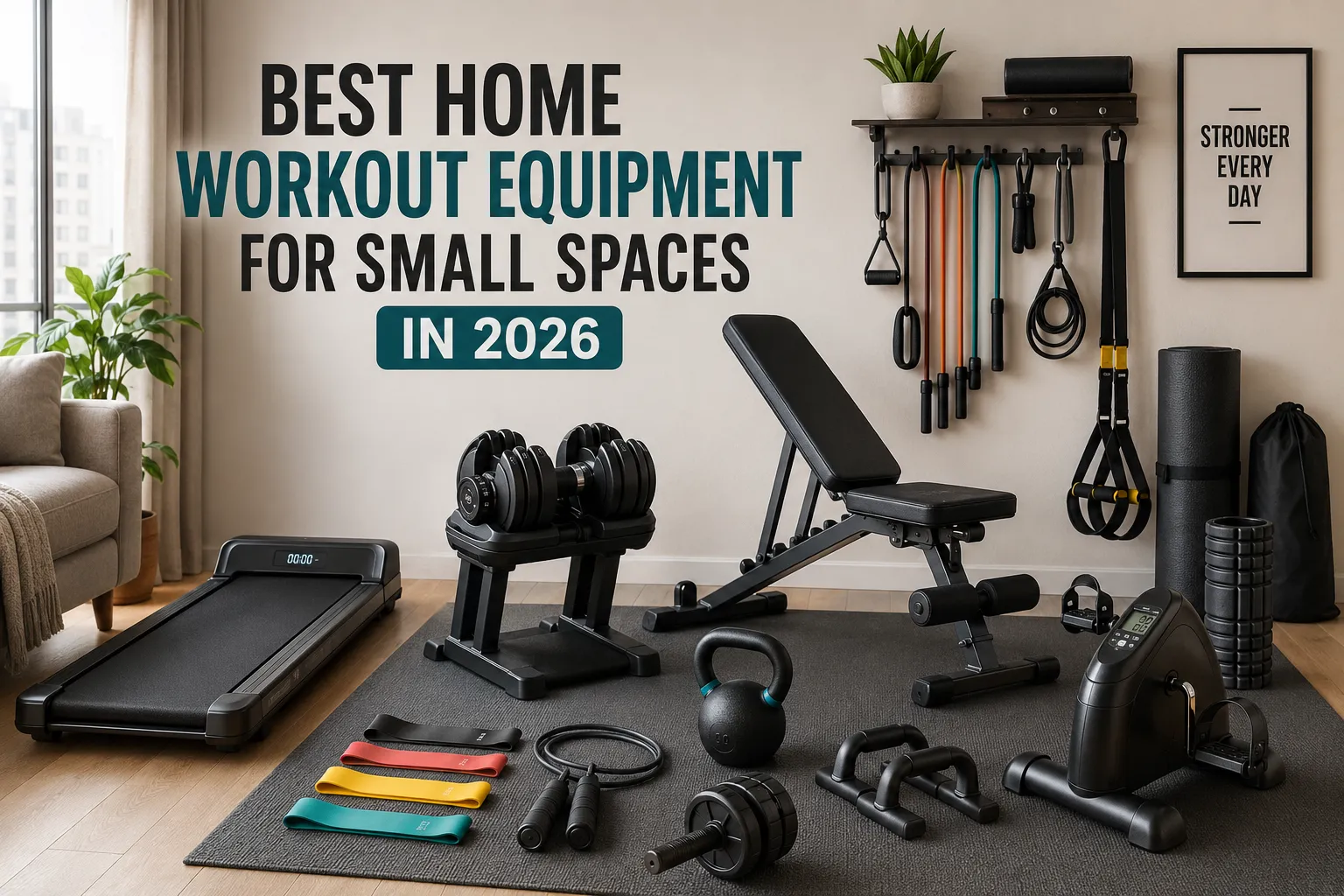
Building a home gym no longer requires a spare bedroom, garage, or collection of full-size commercial machines. In 2026, the best home workout equipment for small spaces combines a compact footprint with versatile performance, quiet operation, easy storage, and enough resistance to support long-term progress.
Apartment dwellers, condo residents, students, parents, remote workers, seniors, and busy professionals can now create an effective personal fitness space in a bedroom, living room, office corner, or multifunctional room. Adjustable dumbbells replace an entire weight rack. A walking pad slides beneath a bed or sofa. Resistance bands fit inside a drawer. A foldable bench stores against a wall. A suspension trainer turns a secure doorway or anchor point into a full-body training station.
The result is a minimalist home gym that supports strength training, cardiovascular fitness, HIIT, functional training, mobility, yoga, Pilates, recovery, and daily exercise without overwhelming the room.
This guide explains how to choose the best compact home gym equipment, compares the leading equipment categories, and provides practical setup ideas for small apartments and homes.
Quick Picks: Best Compact Home Gym Equipment
For most small-space home gyms, the strongest equipment choices are:
| Category | Best Compact Option | Best For |
| Strength | Adjustable dumbbells | Progressive overload and muscle building |
| Portable strength | Resistance bands | Beginners, travel, mobility, and full-body training |
| Functional training | Adjustable kettlebell | Conditioning, power, and functional strength |
| Bodyweight training | Suspension trainer | Full-body workouts with minimal storage |
| Daily cardio | Walking pad | Low-impact walking and under-desk exercise |
| Intense compact cardio | Mini stepper or jump rope | HIIT and calorie-burning workouts |
| Low-impact cardio | Folding exercise bike | Beginners, seniors, and endurance training |
| Full-body cardio | Foldable rowing machine | Strength and cardiovascular conditioning |
| Workout support | Foldable adjustable bench | Presses, rows, split squats, and seated exercises |
| Mobility | Exercise mat and mobility bands | Stretching, yoga, Pilates, and recovery |
| Recovery | Foam roller or massage gun | Muscle soreness and movement preparation |
| Storage | Wall-mounted rack or pegboard | Vertical organization and decluttering |
The best setup is not the one with the most equipment. It is the setup in which every item performs a clear function, fits the available space, and supports consistent exercise.
Why Compact Home Gyms Matter in 2026
Small-space fitness continues to grow because modern homes often serve several purposes at once. A living room may also function as an office, play area, entertainment space, and exercise zone. A bedroom may need to accommodate both storage and training. Many people cannot dedicate permanent floor space to a traditional treadmill, power rack, or fixed dumbbell collection.
This creates demand for apartment-friendly equipment that can be folded, collapsed, rolled, mounted, stacked, or tucked away.
Modern compact fitness equipment increasingly emphasizes:
- Foldable and collapsible frames
- Adjustable resistance
- Multi-functional design
- Quiet operation
- Vertical and under-bed storage
- Lightweight construction
- Connected workouts
- Sensor-enabled equipment
- Adaptive resistance
- Personalized fitness analytics
- AI-assisted training
- Smart coaching
Technology can improve tracking and personalization, but the core principles of effective training remain unchanged. Equipment must allow the user to train safely, progress gradually, and exercise consistently.
What Makes Equipment Suitable for a Small Space?
A product may be described as compact without being practical for an apartment. Evaluate both the storage footprint and the operating footprint before buying.
Compact Footprint
Measure how much floor space the equipment occupies during use. A foldable rowing machine may store vertically but still require substantial length during a workout. A jump rope requires almost no storage but needs lateral and overhead clearance.
Measure:
- Available floor width and length
- Ceiling height
- Doorway width
- Closet depth
- Under-bed clearance
- Wall-storage capacity
- Clearance around furniture
Easy Storage
The best space-saving workout equipment should fold flat, roll easily, hang from a wall hook, fit inside a closet, or slide beneath furniture.
Useful storage features include:
- Transport wheels
- Carry handles
- Folding frames
- Quick-release mechanisms
- Storage pouches
- Wall-mount compatibility
- Stackable components
- Vertical storage positions
Check whether the manufacturer permits vertical storage. Some machines should not be stored upright because of their motor, lubricant, hydraulic system, or frame design.
Multi-Functional Design
Multi-purpose equipment delivers more exercise options per square foot.
Examples include:
- Adjustable dumbbells replacing several fixed dumbbell pairs
- Adjustable kettlebells replacing multiple cast iron kettlebells
- Suspension trainers supporting pushing, pulling, squatting, lunging, and core exercises
- Resistance band systems simulating cable-machine movements
- Adjustable benches supporting flat, incline, and decline positions
Multi-functional equipment helps reduce clutter and limits the need for single-purpose machines.
Quiet Operation
Noise is a major consideration in apartments, condos, shared homes, and upstairs rooms.
Quiet home gym equipment often includes:
- Magnetic resistance
- Belt-driven mechanisms
- Rubber-coated contact points
- Shock absorbers
- Padded decks
- Stable frames
- Soft-grip handles
A quiet motor does not guarantee a quiet workout. Impact noise, vibration, loose components, and dropped weights can still disturb neighbors. Dense flooring tiles or an exercise mat can help absorb vibration and protect the floor.
Adjustable Resistance
Effective strength training depends on progressive overload. The body adapts when resistance, repetitions, range of motion, training density, or exercise difficulty increases over time.
Choose equipment with:
- Multiple weight settings
- Small adjustment increments
- Expandable resistance levels
- Secure locking mechanisms
- Adjustable incline or difficulty
- Enough maximum resistance for future progress
Durability and Stability
Compact equipment should still feel secure during use.
Evaluate:
- Weight capacity
- Frame construction
- Material quality
- Locking systems
- Bench stability
- Handle and grip comfort
- Anchor ratings
- Warranty coverage
- Availability of replacement parts
Lightweight does not always mean unstable, but ultra-light frames may shift during intense exercise.
Best Strength Training Equipment for Small Spaces
1. Adjustable Dumbbells
Adjustable dumbbells are among the best compact home gym equipment choices because one pair can replace an entire fixed-weight rack.
Selectorized dumbbells, variable-weight dumbbells, and adjustable free weights use a dial, pin, plate, or adjustment selector to change the load. Common components include weight plates, handles, grips, locking systems, and storage trays.
Well-known brands in this category include Bowflex, PowerBlock, and JAXJOX.
Benefits of Adjustable Dumbbells
- Support progressive overload
- Replace multiple fixed dumbbell pairs
- Reduce storage requirements
- Work for beginners and intermediate lifters
- Support upper-body, lower-body, and core exercises
- Offer strong value compared with buying a complete fixed set
Exercises include:
- Chest presses
- Shoulder presses
- Rows
- Goblet squats
- Romanian deadlifts
- Lunges
- Biceps curls
- Triceps extensions
- Farmer carries
- Lateral raises
- Split squats
Adjustable Dumbbells vs Fixed Dumbbells
| Adjustable Dumbbells | Fixed Dumbbells |
| Replace several weights | Require multiple pairs |
| Better for small spaces | Require a rack or larger storage area |
| Usually lower total cost | Can become expensive as the set expands |
| Adjustment takes time | Fast transitions between weights |
| More moving parts | Simpler construction |
Adjustable dumbbells are generally the better choice for a small apartment home gym. Fixed dumbbells are more practical when several users train together or when rapid weight changes are essential.
2. Resistance Bands
Resistance bands are affordable, lightweight, portable, and easy to store. They are also among the quietest apartment workout tools.
Common types include:
- Loop bands
- Tube resistance bands
- Fabric resistance bands
- Mini bands
- Pull-up assist bands
- Power bands
- Mobility bands
A complete resistance band system may include handles, a door anchor, carabiners, ankle straps, and a storage pouch.
Brands associated with resistance training include Theraband and Whatafit.
Benefits of Resistance Bands
Resistance bands support:
- Strength training
- Mobility work
- Rehabilitation
- Warm-ups
- Muscle activation
- HIIT circuits
- Functional fitness
- Core workouts
Elastic resistance increases as the band stretches. This makes bands useful for exercises such as rows, chest presses, pull-aparts, squats, lateral walks, curls, triceps extensions, and assisted pull-ups.
Resistance Bands vs Dumbbells
| Resistance Bands | Dumbbells |
| Extremely easy to store | Require more storage space |
| Lightweight and portable | Provide a more stable external load |
| Quiet and apartment-friendly | Better for measurable load progression |
| Useful for mobility and rehabilitation | Better for traditional strength training |
| Resistance changes through the movement | Resistance remains based on the selected weight |
The two tools complement each other. Dumbbells make progressive overload easier to measure, while bands add portability, variable resistance, and exercise variety.
3. Adjustable Kettlebells
Kettlebells support strength, power, conditioning, grip development, and functional training. An adjustable kettlebell replaces several fixed cast iron kettlebells and reduces the storage footprint.
Popular exercises include:
- Kettlebell swings
- Goblet squats
- Turkish get-ups
- Deadlifts
- Cleans
- Snatches
- Single-arm presses
- Farmer carries
- Reverse lunges
The kettlebell’s offset center of mass challenges the core and stabilizing muscles. It is especially effective for dynamic movements and full-body conditioning.
Kettlebell vs Dumbbell
| Kettlebell | Dumbbell |
| Better for swings and ballistic exercises | Better for controlled presses and isolation work |
| Challenges grip and stability | Easier for many beginners |
| Strong option for conditioning | Strong option for traditional resistance training |
| Useful for power development | Useful for balanced load progression |
For a minimalist home gym, an adjustable kettlebell can complement adjustable dumbbells rather than replace them.
4. Suspension Trainers
A suspension trainer uses adjustable straps, handles, foot cradles, buckles, and an anchor to turn body weight into resistance.
TRX is one of the best-known brands in the suspension training category.
A suspension training system supports:
- Rows
- Chest presses
- Triceps extensions
- Biceps curls
- Squats
- Lunges
- Hamstring curls
- Planks
- Knee tucks
- Pike rollouts
- Mountain climbers
The user changes resistance by adjusting body angle, stance, or strap length.
Advantages
- Fits inside a small storage pouch
- Supports full-body workouts
- Provides adjustable difficulty
- Develops core strength and stability
- Works for beginners and experienced users
- Requires almost no permanent floor space
Use only a secure, manufacturer-approved anchor. Door anchors must be positioned correctly, and the door must be structurally suitable and unable to open during exercise.
TRX vs Resistance Bands
| Suspension Trainer | Resistance Bands |
| Uses body weight | Uses elastic resistance |
| Requires a secure anchor | Can be used with or without an anchor |
| Strong stability challenge | Easier for targeted muscle work |
| Excellent for rows and bodyweight presses | Excellent for rehabilitation and accessory exercises |
| Compact and portable | Even smaller and usually less expensive |
5. Push-Up Handles, Boards, and Parallettes
Push-up equipment improves wrist position, increases range of motion, or guides hand placement.
Options include:
- Push-up handles
- Foldable push-up boards
- Parallettes
- Compact dip bars
Push-up handles may reduce wrist extension and allow the chest to move through a greater range of motion. Parallettes support L-sits, elevated push-ups, handstand practice, and advanced bodyweight progressions.
These tools are compact, portable, and suitable for under-bed or closet storage.
6. Doorway Pull-Up Bars and Gymnastic Rings
A doorway pull-up bar supports pull-ups, chin-ups, dead hangs, hanging knee raises, and grip training.
Before purchasing, check:
- Door-frame dimensions
- Maximum load
- Mounting method
- Frame condition
- Ceiling clearance
- Manufacturer restrictions
Gymnastic rings provide even greater exercise variety, including rows, dips, push-ups, pull-ups, and core exercises. However, rings require a secure overhead anchor and enough clearance for safe movement.
7. Ab Wheels and Core Sliders
Ab wheels and core sliders take up almost no storage space but create demanding core workouts.
An ab wheel trains:
- Abdominal muscles
- Shoulder stabilizers
- Lats
- Hip control
- Anti-extension strength
Core sliders support:
- Mountain climbers
- Plank variations
- Hamstring curls
- Sliding lunges
- Pike movements
- Body saws
These tools are inexpensive additions to a compact home fitness setup.
Best Compact Cardio Equipment
1. Walking Pads
A walking pad is a slim treadmill designed primarily for walking. Many models fit beneath a standing desk or store under a bed or sofa.
WalkingPad is a recognized brand name within this category.
Walking pads are especially useful for:
- Remote workers
- Daily walking
- Low-impact cardio
- Increasing general activity
- Small apartments
- Users who prefer steady-state exercise
Common components include a walking deck, motor, display, wheels, safety features, and shock-absorbing elements.
Advantages
- Slim profile
- Quiet operation on suitable surfaces
- Under-desk compatibility
- Easy storage
- Beginner-friendly movement
- Lower impact than running
Check the maximum speed before buying. Some walking pads are intended only for walking, while others permit light jogging.
Walking Pad vs Treadmill
| Walking Pad | Traditional or Foldable Treadmill |
| Smaller storage footprint | Larger frame and deck |
| Better for walking | Better for running and incline work |
| Often suited to under-desk use | Usually includes handrails and a larger console |
| Lower top speed | Higher speed range |
| Easier to store | Better for structured running workouts |
A walking pad is often the better choice for apartment residents focused on daily movement. A treadmill is more appropriate for users who need running speed, incline, or a larger deck.
2. Foldable Treadmills
A folding treadmill offers more speed and training options than a walking pad while reducing storage space after use.
Look for:
- Folded dimensions
- Running deck size
- Motor rating
- User weight capacity
- Shock absorption
- Safety key
- Transport wheels
- Console features
- Noise level
A foldable treadmill still requires a meaningful operating footprint. Measure the room before purchase and leave space behind the running deck for safety.
3. Folding Exercise Bikes
A folding exercise bike delivers low-impact cardiovascular training while storing more easily than many upright or recumbent bikes.
Sunny Health & Fitness is one brand associated with compact cardio equipment.
Useful features include:
- Magnetic resistance
- Adjustable seat height
- Transport wheels
- Display console
- Tablet holder
- Heart-rate sensors
- Multiple resistance levels
- Bluetooth or app compatibility
Folding bikes are particularly suitable for beginners, seniors, and users who prefer seated exercise.
4. Mini Exercise Bikes and Pedal Exercisers
A mini exercise bike, under-desk bike, or pedal exerciser provides light seated movement in a very small footprint.
It can be used while:
- Working at a desk
- Watching television
- Reading
- Sitting in a supportive chair
A pedal exerciser does not provide the stability or intensity of a full exercise bike, but it can help reduce sedentary time and increase daily movement.
Check pedal clearance, base stability, resistance range, and whether the device slides on the intended floor surface.
5. Foldable Rowing Machines
A rowing machine combines cardiovascular conditioning with lower-body drive, core engagement, and upper-body pulling.
Concept2 is a well-known entity in the rowing equipment market, although buyers should compare the dimensions and storage design of specific models before assuming they are suitable for a small room.
A rowing stroke trains:
- Quadriceps
- Glutes
- Hamstrings
- Core
- Back
- Shoulders
- Arms
Compact rowers may use magnetic, air, water, or hydraulic resistance. Each system affects noise, feel, maintenance, and storage.
Rowing Machine vs Exercise Bike
| Rowing Machine | Exercise Bike |
| Engages more muscle groups | Focuses primarily on lower-body cardio |
| Requires more length during use | Often uses less operating space |
| Technique takes longer to learn | Movement is easier for many beginners |
| Strong full-body conditioning option | Strong low-impact endurance option |
| May fold vertically | Folding bikes may store more compactly |
Choose a rower for full-body conditioning and an exercise bike for simpler, seated cardio.
6. Mini Steppers
A mini stepper simulates stair climbing while using very little floor space.
It primarily trains:
- Glutes
- Quadriceps
- Hamstrings
- Calves
- Core stabilizers
Some models include resistance bands for upper-body movement.
Mini Stepper vs Walking Pad
| Mini Stepper | Walking Pad |
| Smaller storage footprint | Longer deck |
| Higher lower-body effort | Better for natural daily walking |
| Useful for short cardio intervals | Better for longer steady-state sessions |
| Limited stride pattern | Familiar walking movement |
| Often less expensive | Usually more expensive |
A mini stepper suits users who want compact, higher-effort cardio. A walking pad is better for longer sessions and under-desk movement.
7. Jump Ropes and Smart Jump Ropes
A jump rope is one of the most space-efficient cardio tools available.
Benefits include:
- High workout intensity
- Improved coordination
- Portable storage
- Minimal cost
- Suitability for HIIT
- Agility and footwork development
A smart jump rope may track repetitions, workout duration, and estimated energy expenditure through a connected app.
Jumping is high impact and may be noisy in an apartment. Users should consider floor construction, ceiling height, neighbor proximity, and joint tolerance.
Functional Training Equipment
Compact functional training tools add variety without requiring a large machine.
Options include:
- Medicine balls
- Slam balls
- Balance trainers
- Agility ladders
- Sandbags
- Core sliders
Medicine balls and sandbags support carries, squats, presses, rotational exercises, and conditioning. Slam balls require a suitable impact surface and may be inappropriate for upstairs apartments because of noise and vibration.
An agility ladder folds into a small bag but needs enough floor length to use safely.
Mobility and Recovery Equipment
Exercise Mats and Yoga Mats
A workout mat creates a comfortable surface for:
- Yoga
- Pilates
- Stretching
- Mobility training
- Bodyweight exercise
- Core workouts
Look for a non-slip surface, adequate cushioning, durable edges, and easy cleaning.
Lululemon is one recognizable entity in the yoga and fitness accessory market, though the best mat depends on thickness, grip, size, and budget.
Foam Rollers
A foam roller can support warm-ups, mobility work, and post-workout recovery.
Common uses include:
- Calf rolling
- Quadriceps rolling
- Glute work
- Upper-back mobility
- Lat release
Foam rolling may temporarily improve range of motion and reduce the perception of muscle tightness, but it does not replace medical care or structured rehabilitation.
Massage Guns
A compact massage gun delivers percussive stimulation to targeted muscles.
Useful features include:
- Multiple speed settings
- Interchangeable heads
- Quiet motor
- Low device weight
- Travel case
- Long battery life
Avoid using a massage gun directly on bones, joints, the front of the neck, injured tissue, or areas with reduced sensation. People with relevant medical conditions should seek professional guidance.
Stretch Straps and Mobility Bands
Stretch straps help users maintain positions during hamstring, calf, hip, and shoulder stretches.
Mobility bands assist with:
- Shoulder preparation
- Hip mobility
- Ankle mobility
- Warm-ups
- Assisted stretching
- Joint-control drills
They store easily in drawers, pouches, or wall-mounted organizers.
Balance Pads
A balance pad creates an unstable surface that challenges coordination and proprioception.
Exercises include:
- Single-leg stands
- Supported squats
- Lunges
- Rehabilitation drills
- Balance practice
Seniors and beginners should position the pad near a stable support and progress gradually.
Home Gym Furniture and Storage
Foldable Adjustable Benches
A workout bench expands the usefulness of dumbbells and resistance bands.
Common positions include:
- Flat
- Incline
- Decline
- Upright
Exercises include:
- Bench presses
- Incline presses
- Seated shoulder presses
- Supported rows
- Bulgarian split squats
- Seated curls
- Triceps extensions
Foldable Bench vs Flat Bench
| Foldable Adjustable Bench | Fixed Flat Bench |
| Supports several angles | Supports one primary position |
| Easier to store | Often simpler and more rigid |
| More moving parts | Fewer adjustment mechanisms |
| Better for multifunctional rooms | Better for permanent gym space |
Check the bench’s total load rating, backrest stability, hinge design, footprint, and folded dimensions.
Wall-Mounted Storage
Wall-mounted storage preserves floor space and helps organize:
- Resistance bands
- Jump ropes
- Stretch straps
- Suspension trainers
- Yoga mats
- Lightweight accessories
Options include:
- Pegboards
- Wall hooks
- Shelves
- Resistance band racks
- Vertical organizers
Only mount storage into an appropriate wall structure with suitable hardware.
Dumbbell Stands and Weight Racks
A vertical dumbbell stand or compact weight rack can reduce clutter and prevent tripping hazards.
Store heavy items low to improve stability. Do not overload shelving, wall racks, or furniture that was not designed for fitness equipment.
Under-Bed and Closet Storage
Under-bed storage boxes work well for:
- Bands
- Sliders
- Yoga blocks
- Stretch straps
- Small recovery tools
Heavy dumbbells should be stored only in containers and locations rated for the load.
Small Home Gym Layout Ideas
Bedroom Gym
A bedroom gym works best with equipment that can disappear after the workout.
Recommended equipment:
- Adjustable dumbbells
- Resistance bands
- Exercise mat
- Foldable bench
- Core sliders
- Ab wheel
- Compact massage gun
Store the bench under the bed or against a wall. Keep the center of the room clear for lunges, push-ups, squats, yoga, and Pilates.
Living Room Gym
A living room gym should be easy to set up and quick to restore.
Recommended equipment:
- Walking pad
- Adjustable kettlebell
- Mini stepper
- Suspension trainer
- Exercise mat
- Smart jump rope
- Portable organizer
Use neutral storage furniture or a rolling cart to consolidate accessories.
Office Workout Corner
An office fitness corner is ideal for remote workers.
Recommended equipment:
- Under-desk treadmill
- Pedal exerciser
- Resistance bands
- Balance pad
- Stretch strap
- Compact dumbbells
Short movement breaks can include band pull-aparts, squats, calf raises, shoulder mobility, and light walking.
Balcony Workout Area
A balcony may support:
- Yoga
- Mobility
- Bodyweight training
- Resistance bands
- Jump rope
- Kettlebell exercises
Use the space only when the surface, railing, weather conditions, and available clearance are safe. Do not leave electronic devices, elastic bands, foam products, or metal equipment exposed to heat, rain, or direct sunlight.
Multifunctional Room
A multifunctional room benefits from a modular home gym system built around:
- Foldable equipment
- Wall storage
- Adjustable weights
- Portable cardio
- Stackable containers
- Under-bed storage
Assign every item a fixed storage position. This reduces setup time and prevents clutter.
Best Equipment by Fitness Goal
Building Muscle
For muscle growth and strength training, prioritize:
- Adjustable dumbbells
- Foldable bench
- Resistance bands
- Adjustable kettlebell
- Doorway pull-up bar
This combination supports the main movement patterns: press, pull, squat, hinge, lunge, carry, and stabilize.
Fat Loss and Conditioning
Exercise supports energy expenditure, cardiovascular health, and muscle retention, but fat loss depends on overall energy balance.
Useful equipment includes:
- Jump rope
- Mini stepper
- Walking pad
- Adjustable kettlebell
- Resistance bands
These tools support HIIT, circuit training, and daily activity.
Cardiovascular Fitness
Choose among:
- Walking pad
- Folding treadmill
- Folding exercise bike
- Compact rower
- Mini stepper
- Jump rope
The most effective cardio equipment is the option you can use safely and consistently.
Mobility and Recovery
A compact mobility setup can include:
- Yoga mat
- Foam roller
- Mobility bands
- Stretch strap
- Massage gun
- Balance pad
These tools support flexibility, joint mobility, muscle preparation, and recovery.
Full-Body Training
The most versatile full-body options are:
- Suspension trainer
- Adjustable dumbbells
- Adjustable kettlebell
- Resistance band system
- Rowing machine
A suspension trainer provides the smallest storage footprint. Adjustable weights provide more measurable resistance progression.
Best Home Gym Equipment for Beginners
Beginners should start with simple, versatile equipment rather than purchasing a complete gym immediately.
A practical starter kit includes:
- Exercise mat
- Resistance band set
- Adjustable dumbbells
- Jump rope, mini bike, or walking pad
- Foam roller
Choose equipment that is:
- Easy to assemble
- Simple to adjust
- Quiet
- Stable
- Beginner-friendly
- Easy to store
- Suitable for gradual progression
Add a bench, kettlebell, suspension trainer, or larger cardio machine after your preferred workout style becomes clear.
Small Home Gym Setups by Budget
Affordable Starter Setup
A budget-friendly home gym may include:
- Exercise mat
- Loop bands
- Tube resistance bands
- Jump rope
- Core sliders
- Ab wheel
This setup supports bodyweight workouts, mobility, resistance training, core work, and cardio intervals.
Mid-Range Setup
A balanced setup may include:
- Adjustable dumbbells
- Foldable bench
- Resistance band system
- Yoga mat
- Mini stepper
- Foam roller
This combination supports progressive strength training, low-impact cardio, and recovery.
Premium Compact Setup
A premium setup may include:
- Smart adjustable dumbbells
- Connected resistance trainer
- Foldable bench
- Walking pad
- Compact massage gun
- Wearable fitness tracker
- Wall-mounted storage system
Smart equipment may offer connected workouts, app compatibility, adaptive resistance, smart coaching, and personalized fitness analytics. These features are useful only when the equipment also meets the user’s needs for durability, dimensions, resistance, and safety.
Common Small Home Gym Problems
Limited Storage
Use:
- Adjustable weights
- Foldable machines
- Wall hooks
- Pegboards
- Vertical shelving
- Under-bed storage
- Stackable organizers
Equipment Clutter
Create a fixed storage position for every item. Keep frequently used tools accessible and store occasional-use equipment farther away.
Noisy Workouts
Reduce noise by:
- Using dense flooring
- Avoiding dropped weights
- Choosing magnetic resistance
- Tightening loose components
- Selecting stable equipment
- Avoiding high-impact movements at inappropriate times
Limited Workout Variety
Choose multi-purpose equipment such as:
- Adjustable dumbbells
- Suspension trainers
- Resistance bands
- Adjustable kettlebells
- Foldable benches
Lack of Motivation
Reduce setup friction. Keep the exercise area clean, schedule workouts, and track progress. Connected fitness devices can help, but consistent routines matter more than advanced technology.
How to Organize Workout Equipment in a Small Room
Divide equipment into four groups:
- Frequently used
- Occasionally used
- Heavy
- Lightweight
Store heavy items close to the floor. Hang bands, straps, and jump ropes on hooks. Use vertical stands for adjustable dumbbells and kettlebells.
Useful storage solutions include:
- Pegboard organizers
- Dumbbell stands
- Under-bed boxes
- Wall racks
- Closet shelving
- Stackable bins
- Rolling carts
Do not block doors, walkways, heating vents, electrical panels, or emergency exits.
Buying Checklist
Before purchasing compact fitness equipment, confirm:
- The in-use dimensions fit the room
- The folded dimensions fit the storage area
- The equipment can pass through doorways
- The ceiling provides enough clearance
- The floor can support the load
- The weight capacity is suitable
- The resistance range supports progression
- The machine is quiet enough for the location
- Assembly and maintenance are manageable
- Transport wheels work on the intended flooring
- The warranty is appropriate for the price
- Replacement parts or service are available
- App features are not required for basic operation unless desired
Frequently Asked Questions
What is the best home workout equipment for small spaces?
The best options combine broad exercise variety with compact storage. Adjustable dumbbells, resistance bands, suspension trainers, foldable benches, walking pads, adjustable kettlebells, and compact cardio machines are among the most practical choices.
Can you build a home gym in an apartment?
Yes. A functional apartment home gym can be built with quiet, portable, foldable, and multi-purpose equipment. A mat, resistance bands, adjustable dumbbells, and one compact cardio tool can support a complete routine.
What equipment gives the best full-body workout?
Suspension trainers, adjustable dumbbells, kettlebells, resistance band systems, and rowing machines all support full-body exercise. A suspension trainer provides the smallest storage footprint, while adjustable weights provide clearer load progression.
Are adjustable dumbbells worth it?
They are usually worth considering when storage is limited. One pair replaces several fixed dumbbells and supports progressive overload. Compare the maximum load, adjustment increments, locking mechanism, handle comfort, tray design, warranty, and replacement-part availability.
Is a walking pad better than a treadmill?
A walking pad is better for under-desk walking, small apartments, quiet daily activity, and easy storage. A treadmill is better for running, higher speeds, incline training, and structured endurance workouts.
What compact equipment burns the most calories?
Jump ropes, rowing machines, treadmills, kettlebells, and mini steppers can support high-intensity exercise. Actual calorie expenditure depends on body size, exercise intensity, session duration, fitness level, and technique.
How much space do I need for a home gym?
You need enough clear space to perform each exercise safely and enough storage space for the equipment afterward. A band-and-dumbbell setup requires much less room than a treadmill or rowing machine.
What equipment should beginners buy first?
Beginners should generally start with an exercise mat, resistance bands, and adjustable dumbbells. Add a walking pad, jump rope, mini bike, or stepper for cardio based on joint tolerance and available space.
How do I organize workout equipment in a small room?
Use vertical storage, wall hooks, under-bed boxes, compact stands, stackable containers, and closet shelving. Keep heavy equipment low and lightweight accessories on walls or shelves.
What is the best foldable fitness equipment?
Useful foldable options include adjustable benches, folding exercise bikes, foldable treadmills, compact rowing machines, and collapsible push-up boards. The best choice is the product whose folded and operating dimensions fit the actual room.
Final Verdict
The best home workout equipment for small spaces in 2026 is equipment that delivers meaningful training value without creating unnecessary clutter.
For most people, a strong minimalist home gym begins with:
- Adjustable dumbbells
- Resistance bands
- Exercise mat
- Foldable bench
- Compact cardio equipment
- Basic mobility and recovery tools
Apartment dwellers should prioritize quiet operation, compact footprints, vertical storage, and low-impact movement. Beginners should prioritize easy setup and simple resistance progression. Intermediate lifters should consider heavier adjustable weights, a stable bench, and equipment that supports long-term progressive overload.
A practical small-space home gym follows one rule:
Every item should earn its place by supporting several exercises, storing efficiently, and helping you train consistently.
Adjustable weights consolidate resistance. Foldable machines reclaim floor space. Wall-mounted organizers reduce clutter. Portable fitness equipment allows flexible training. Together, these tools can create an effective apartment gym, micro gym, or personal fitness corner for strength, cardio, mobility, recovery, and everyday health.


